
What does force-free dog training mean?
Force-free dog training teaches behavior by using rewards, clear communication, and humane management rather than pain, fear, intimidation, or physical punishment. The approach is based on learning science: dogs are more likely to repeat behaviors that produce desirable outcomes.
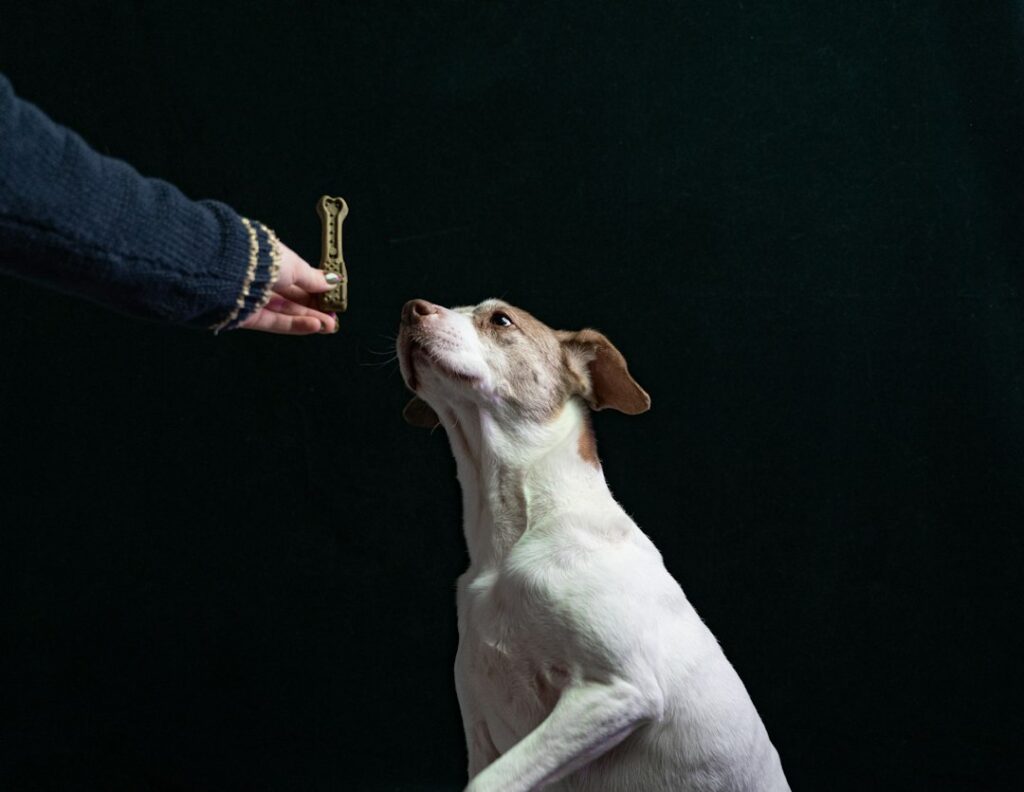
A reward may be food, play, access to a favorite place, praise, sniffing time, or another activity the dog values. The goal is not to bribe a dog indefinitely. The goal is to show the dog which behavior works, then gradually build reliability in different situations.
Force-free training does not mean allowing unwanted behavior. It includes boundaries, routines, environmental changes, prevention, and consistent follow-through. The difference is that the dog is guided toward an acceptable behavior instead of being harmed or frightened for making a mistake.
How does positive reinforcement change behavior?
Positive reinforcement means adding something desirable immediately after a behavior, which makes that behavior more likely to happen again. For example, if a dog sits when asked and receives a small treat, the dog has a reason to repeat sitting in similar circumstances.
Timing matters. The reward must follow the behavior quickly enough for the dog to connect the two events. A reward delivered several seconds later may be interpreted as reinforcement for standing, jumping, barking, or moving away instead.
A useful training sequence is:
- Set up the environment so the dog can succeed.
- Give a simple cue or wait for a desired behavior.
- Mark the correct moment with a word such as “yes” or a click.
- Deliver the reward immediately.
- Repeat in short sessions.
- Gradually practice around more distractions.
The reward should match the difficulty of the task. A dog may work for kibble in a quiet room but need higher-value food or a favorite toy near bicycles, unfamiliar dogs, or busy sidewalks.
Why does punishment often create new problems?
Punishment can stop a behavior temporarily without teaching the dog what to do instead. A dog that is punished for barking may become quieter, but may also feel more threatened and react more intensely the next time the trigger appears.
Fear-based methods can also affect the relationship between a dog and the person handling the leash. If the dog associates pain or startling corrections with children, visitors, other dogs, or outdoor settings, those situations may become more difficult.
Common risks include:
- Increased anxiety or defensive aggression
- Avoidance of the person giving corrections
- Suppressed warning signals, such as growling
- Confusion about which behavior is expected
- Reduced willingness to explore or learn
- Stronger reactions when the punishment is absent
This does not mean every correction produces severe harm, or that every dog responds identically. It means punishment carries behavioral risks that are unnecessary when safer teaching methods are available.
What does the science say about rewards and humane training?
Behavioral science consistently supports reinforcement-based learning as an effective way to teach animals. Dogs learn through consequences, repetition, emotional associations, and changes in their environment. Humane methods use those mechanisms without deliberately causing pain or fear.
A force-free approach also recognizes that behavior is influenced by more than obedience. Sleep, illness, hunger, pain, age, genetics, past experience, and the surrounding environment can all affect a dog’s response.
For instance, a dog that suddenly refuses to walk may not be stubborn. The dog could be uncomfortable on a hot surface, frightened by construction noise, experiencing pain, or overwhelmed by a crowded route. A behavior plan is more effective when those possibilities are considered before training begins.
Is force-free training permissive?
No. Force-free training can be structured, consistent, and firm without being harsh. Dogs still need rules about doorways, jumping, leash pressure, household items, greetings, and safe interactions.
The difference is in how those rules are taught. A dog that jumps on visitors can be prevented from rehearsing the behavior, rewarded for keeping four paws on the floor, and given a predictable greeting routine. A dog that grabs household objects can be redirected to an appropriate toy while access to tempting items is reduced.
Management is a major part of humane training. Baby gates, closed doors, leashes, secure storage, visual barriers, and planned routines prevent repeated practice of unwanted behaviors while new habits develop.
How can this work in Providence, RI homes and neighborhoods?
Urban and densely settled environments often create training challenges that require careful planning. Apartment hallways, shared entrances, narrow sidewalks, traffic noise, stairwells, elevators, and close encounters with unfamiliar people or dogs can make some behaviors harder to practice.

Seasonal conditions also matter. Snow, ice, heavy rain, heat, and early darkness can change a dog’s willingness to walk or focus outdoors. Salt and deicing materials may irritate paws, while slippery surfaces can make a dog hesitant or unsteady. Short indoor training sessions can maintain progress when outdoor conditions are uncomfortable.
Practical adjustments may include:
- Practicing leash skills in a quiet indoor area before moving outside
- Choosing less crowded walking times
- Carrying rewards in a secure container during neighborhood walks
- Allowing extra sniffing time to reduce frustration
- Using well-lit routes during darker seasons
- Checking paws after walks in winter conditions
- Increasing distance from triggers rather than forcing close exposure
The most effective training plan fits the household’s actual routine. A behavior that works only in a quiet training room may not yet be ready for a busy sidewalk.
What should a dog learn instead of barking, jumping, or pulling?
Every unwanted behavior should have a replacement behavior that is realistic for the dog.
For barking at a window, the replacement may be moving to a mat, turning toward the handler, or leaving the room. For jumping, the dog can be reinforced for sitting or standing calmly. For leash pulling, the dog can learn that a loose leash makes forward movement continue.
Replacement behaviors work best when they meet the same underlying need. A dog pulling toward a scent may need opportunities to sniff. A dog barking at a visitor may need distance, a quiet resting place, and a predictable greeting routine. A dog nipping during play may need shorter play sessions, pauses, and suitable chew or tug options.
Simply saying “no” does not provide that information.
How should dog owners handle mistakes?
Mistakes are information, not evidence that a dog is being defiant. If a dog cannot respond to a cue, the task may be too difficult, the environment too distracting, the reward too weak, or the dog too tired or stressed.
Lower the difficulty and try again. A dog that cannot stay while a visitor enters may first practice staying for one second in a quiet room. A dog that lunges at another dog may need more distance, fewer triggers, or a shorter walk.
Training should stop before frustration becomes overwhelming. Several brief sessions are usually more productive than one long session filled with repeated failure.
When is extra help necessary?
Some behavior concerns require added caution, especially biting, repeated fights, severe panic, escape attempts, sudden aggression, or behavior that may be connected to pain or illness. A veterinary examination is appropriate when behavior changes abruptly or physical discomfort is possible.
For serious safety concerns, guidance from a qualified, reward-based behavior professional may be necessary. The person providing help should be able to explain the methods clearly, identify risks, and avoid tools or techniques intended to cause pain or fear.
Force-free training is not a single trick or treat-based shortcut. It is a practical application of learning science that combines reinforcement, prevention, emotional safety, realistic expectations, and attention to the dog’s physical and social environment.